
The installation of CFA (Continuous Flight Auger) piles requires precise control of every stage of the operation. During drilling and the subsequent concrete pouring process, even a minor anomaly can compromise pile quality and generate additional costs for the contractor.
A CFA pile datalogger helps operators monitor and record the main operating parameters in real time. This allows them to identify potential problems early and check that each pile meets the project specifications.
But what risks can arise when operators fail to monitor drilling operations correctly? And how can a data acquisition system help prevent costly mistakes on site?
CFA Piles: What Errors Can Compromise the Work?

DAT instruments dataloggers help operators prevent errors and identify potential problems during CFA piling operations.
CFA technology uses a continuous flight auger to drill into the ground. Once the auger reaches the required design depth, concrete flows through its hollow stem as the operator gradually withdraws it from the ground.
This stage requires particular attention. Operators must carefully coordinate the auger extraction speed with the volume of concrete they pump into the pile.
What happens if the auger moves upwards too quickly? What if the concrete flow rate suddenly drops?
In both cases, the pile may receive insufficient concrete. This can create discontinuities and defects that compromise the foundation’s performance.
Inadequate pressure or interruptions in concrete pumping can also cause serious problems.
Without continuous monitoring, operators may not notice these anomalies until they complete the work. At that point, corrective action becomes much more difficult and expensive.
CFA Pile Datalogger: Which Parameters Should You Monitor?
Effective monitoring requires the acquisition and display of all the main parameters related to ground drilling and concrete pumping.
Depending on its configuration and the sensors installed, a CFA pile datalogger can monitor:
- Drilling depth.
- Auger penetration and extraction speed.
- Rotary torque.
- Rotation speed.
- Mast inclination.
- Concrete pressure.
- Instantaneous concrete flow rate.
- Total volume of concrete pumped.
- Ratio between concrete volume and pile length.
- Duration of the various operating stages.
By displaying these values in real time, the system allows operators to follow the entire process and intervene quickly whenever they detect abnormal readings.
Monitoring Concrete Pouring to Prevent Defective Piles
The relationship between auger extraction speed and concrete volume plays a crucial role in CFA pile installation. Operators must monitor and correlate these two parameters continuously.
The monitoring system displays drilling depth, extraction speed, concrete pressure and flow rate simultaneously.
This allows potentially critical situations to be identified, such as:
- Sudden reductions in concrete flow rate.
- Interruptions in concrete pumping.
- Excessive auger extraction speed.
- Pressure levels outside the expected range.
- Concrete quantities that are inconsistent with the depth reached.
Accurate monitoring helps reduce the risk of installation defects, minimise material waste and improve the overall quality of production.
Automatic Monitoring with DAT instruments Dataloggers
DAT instruments designs dataloggers that acquire and display operating parameters directly on site.
The DAT TinyLog and DAT WideLog systems display instantaneous and average values on a touchscreen. Operators can also view graphs that show how each parameter changes with depth.
This allows them to monitor drilling and concrete pouring throughout the entire pile installation process.
Depending on the model and configuration, the systems can also automatically manage various operating stages, reducing the need for manual intervention.
Available functions include:
- Automatic start-up of the drilling rig when data recording begins.
- Automatic stopping of the drilling rig’s downward movement when the preset depth is reached.
- Automatic management of the auger extraction phase.
- Recognition of auger extension changes and suspension of data recording, where supported by the configuration.
Automation helps simplify on-site operations and ensures more consistent data collection.
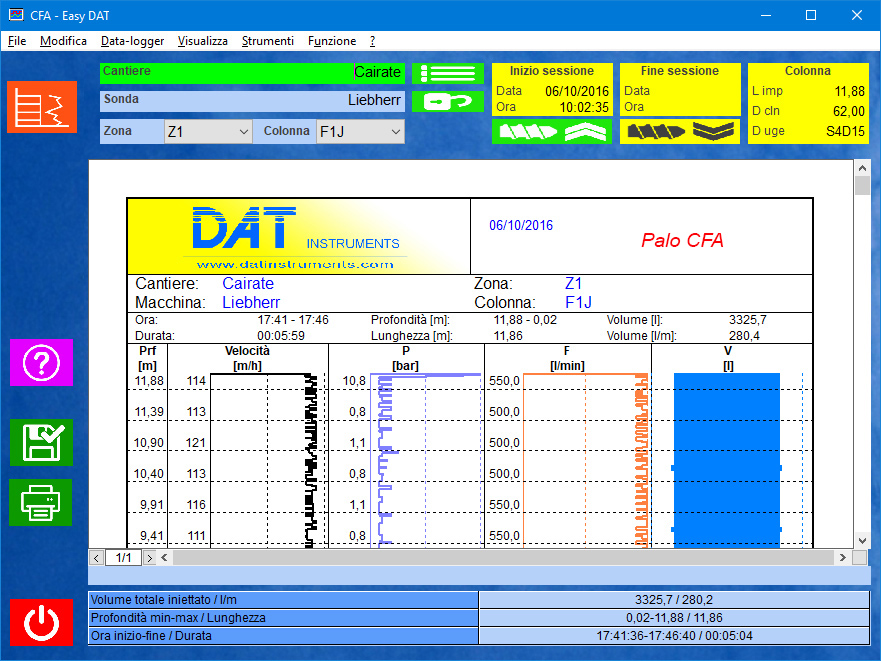
Example of a CFA pile: ACP certification report.
Checking CFA Pile Verticality
Besides drilling and concrete pouring parameters, operators must also check that each pile follows the correct inclination.
A verticality error can cause the pile to deviate from its designed position and affect the foundation geometry.
DAT instruments dataloggers can acquire mast inclination along both the X and Y axes through dedicated sensors.
Operators can view the machine’s orientation directly on the display and check that drilling follows the correct direction.
Inclination monitoring provides an additional tool to improve installation accuracy and reduce the risk of errors that become difficult to correct once the work is complete.
Traceability and Reports for Every Pile
A CFA pile datalogger also offers another important advantage: it automatically records all the parameters associated with each installation operation.
After completing the work, operators can transfer the recorded data to a PC for storage, analysis and export.
With Easy DAT software, users can organise the collected data, generate graphs and tables, and create detailed reports.
This provides the contractor with technical documentation covering:
- Pile identification and working area.
- Actual depth reached.
- Total quantity of concrete used.
- Concrete pressure and flow rate during pouring.
- Auger extraction speed.
- Mast inclination.
- Installation times.
Contractors can use this information to monitor production, verify installation procedures and prepare documentation for the site supervisor or client.
Automatic data recording also reduces the need for handwritten notes. As a result, contractors can improve the reliability and traceability of the collected information.

Which Datalogger Should You Choose for CFA Piles?
Choosing the right monitoring system depends on several factors, including the drilling rig, the parameters you need to monitor and the required level of automation.
DAT instruments offers several solutions for monitoring special foundation works, including DAT TinyLog, DAT WideLog, JET 4000 AME / J and JET SDP / IB.
Operators can configure these systems to acquire the main drilling and concrete pouring parameters, display real-time data and automatically manage certain operating stages.
The goal goes beyond simply recording what happens on site. A CFA pile datalogger gives operators a practical tool to control the installation process, detect anomalies and improve work quality.
Investing in a CFA pile datalogger helps contractors improve production control, reduce installation errors and limit the costs associated with non-compliant operations.
Would you like to know which DAT instruments solution is best suited to your CFA drilling rig?
Contact our team: we will help you identify the data acquisition system that best meets the requirements of your construction site.